

Restaurant late arrival policy: how long to hold a table for late guests, and what they get
Four decisions, made once, so nobody has to make them at the door on a busy night.
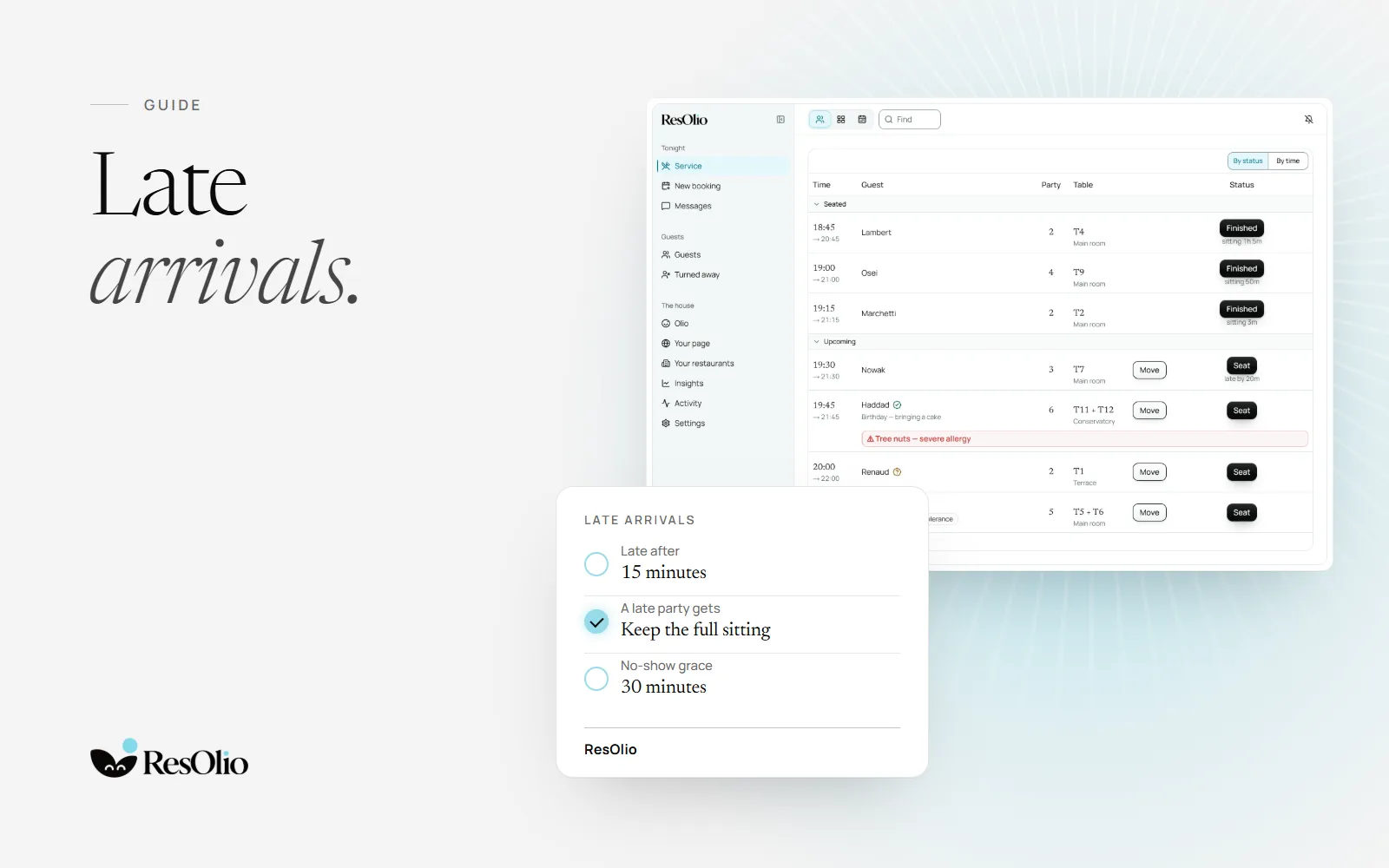
Every restaurant has a late arrival policy, written or not. If it isn’t written, it is whatever the host decides at the door on a busy Friday.
A written restaurant late arrival policy settles it once. It says how long to hold a table for late guests, what a late party gets when it sits down, and when you give the table away. Here is how to choose each, the wording to copy, and how ResOlio runs it on the night.
How long to hold a table for late guests
There is no rule everyone follows. Pick a number your room can live with, such as 10, 15 or 20 minutes, and use it every night.
Three things decide it:
- The next booking on that table. If the table turns again at nine, a long hold eats into the next party’s time.
- Your door. If walk-ins are queuing, a table held for twenty minutes is twenty minutes of guests you turn away.
- The party’s size. A table for ten is harder to give away at short notice than a table for two, so you may hold it a little longer.
A fixed hold is also easier on guests. In a Cornell study of how diners see reservation policies (2011), guests who knew a policy found it fairer, and holding a table for the guest was among the policies rated most acceptable.
In ResOlio, “Late after” in Settings › General decides when a party shows as late on the service screen. A new restaurant starts at 15 minutes. The guestlist then says how late they are, and their table on the floor map shows a clock.


What a late party gets: the time left, or a full sitting
This is the half of the policy that is easy to forget. When a party sits down twenty minutes late, does their table still end at the time it was booked until, or do they get their full time from when they sit?
- The time that is left. The table is needed back when it always was. A party twenty minutes late has twenty minutes less. It protects the next booking, but it can feel abrupt if nobody says so in advance.
- A full sitting. The party gets the whole sitting from when they sit down. It is kind, but on a full night it can push into the next party’s time.
There is a middle way: give a full sitting when the table is free afterwards, and keep the booked end when it isn’t.
In ResOlio, “Late arrivals” in Settings › Availability offers both. “Keep the booked end” is the first. “Keep the full sitting” gives a party that arrives past your late time a whole sitting from when it sits down, unless the next party has that table: then the booked end is kept. That is the middle way, done for you.
When late becomes a no-show
The hold and the no-show are two different times. After the hold, you may give the table to someone at the door. After the no-show time, you stop expecting the party at all.
Before you mark anyone a no-show, check whether they were reached. A reminder that never arrived is not their fault. A party that confirmed and is twenty minutes late is worth a call.
In ResOlio, “No-show grace” in Settings › General sets how long after the booking time a party can be marked a no-show. A new restaurant starts at 30 minutes. Once your team has marked anyone in that day, a party still not here when the grace is over is marked a no-show by itself. Walk-ins never are, a no-show marked this way is never held against the guest, and Restore takes it back.
The table it frees goes back to the floor. On Pro, with the waiting list on, a table freed tonight is offered by email to the first party waiting that it fits, and held for seven minutes unless you change it.
Groups that arrive in pieces
A large table does not always arrive together. Decide in advance whether you seat a group when the first guests come, when most of them are here, or only when everyone is.
Say it in your policy. “We seat groups once most of the party has arrived” saves an argument at the door.
In ResOlio, a booked party’s next step on the guestlist is Seat. If you greet guests at the door before seating them, tick “Mark guests as arrived before seating” in Settings › General: Arrived then comes first, and the guestlist shows how long each party has waited at the door. A party marked Arrived cannot be marked a no-show, because they came.
If fewer people come than booked, change the party size on the booking.
Telling guests before they arrive
A late rule guests discover at the door feels like a punishment. The same rule read before booking feels like information.
- Put it on your booking page, in your house rules, which guests agree to when they book.
- Remind them the day before, with a link to their booking.
- Give them a way to say they are late. A phone number works, but it rings during service.
In ResOlio, from Starter, a guest can write to you from their booking’s page, and a turquoise speech bubble beside their name on the guestlist means they are waiting for your reply. Where Olio is on, the chat on that page also offers “We’ll be late”, and Olio passes it on to you.
On the night: call, move, or give the room longer
When a party is late, you have three moves.
- Call. The guest’s phone is on their booking, one tap away. Call the large tables first.
- Move. If the party will sit later, give them a table that is free later, and keep their first table for someone at the door. In ResOlio, tap their name in the floor map’s guest list, and the tables that can take them light up.
- Give the room longer. When the kitchen falls behind, every party is late to finish. In ResOlio, “Give the room longer” adds time to every party at a table in one go, after showing who can take it and who cannot, and why. For one party, “They need longer” adds 10, 15 or 30 minutes. Both are on every plan.
Wording for your restaurant late arrival policy
Change the minutes to suit your room.
If you keep the booked end
“We hold your table for 15 minutes. If you arrive later, we will seat you if we can, and your table is still needed at the time first booked.”
If you give a full sitting when you can
“We hold your table for 15 minutes. Running late? Tell us, and we will keep your full time at the table whenever the next booking allows.”
For groups
“We seat groups once most of the party has arrived. If you will be fewer, please let us know before you come.”
Put these in your house rules. In ResOlio, leave the cancelling deadline out: your page already writes it from your settings. See how to write a cancellation policy.
How ResOlio does it
- A late flag, on every plan. “Late after” decides when a party shows as late, on the guestlist and the floor map. See General settings.
- Your late rule, on every plan. Keep the booked end, or keep the full sitting when the next party allows. See Availability.
- No-shows marked on time, on every plan. After the grace you set, by hand, or by themselves once your team is marking guests in. See booking statuses.
- Arrived before seating, on every plan. A switch, off unless you turn it on.
- Give the room longer, on every plan. See running late.
- Guests write to you, from Starter. A mark on the guestlist shows who is waiting for a reply.
- The waiting list and the no-show record, on Pro. A freed table finds its next party, and repeat no-shows count only when the guest was reached.
Free takes up to 50 bookings a month. Every plan is on the pricing page.
Questions
How long should a restaurant hold a table?
Long enough to be fair, short enough to give the table away: 10, 15 or 20 minutes, the same every night. Hold a large table a little longer if it is hard to resell. ResOlio shows a party as late after 15 minutes unless you change it.
Should a late party get less time?
It depends on what follows. If another booking needs the table, keep the booked end and say so in advance. If not, giving the full sitting costs you nothing. ResOlio’s “Keep the full sitting” does both: a full sitting unless the next party has the table.
When do I mark a no-show?
After a set time past the booking, once you have tried to reach the guest. In ResOlio, No-show is offered only after the grace you set, 30 minutes for a new restaurant, and a no-show marked by itself never counts against the guest.
Do I seat a party before everyone arrives?
Decide once and write it down: when the first guests come, when most are here, or when everyone is. In ResOlio, you can mark a party Arrived first and seat them when ready, and the guestlist shows how long they have waited.
Should I call a late party?
Yes, especially large tables. A short call tells you whether to hold the table or give it away. In ResOlio, the guest’s phone is on their booking, one tap away.
Can I stop people who are always late from booking online?
Not for lateness. ResOlio’s no-show record, on Pro, counts no-shows where the guest was reached, not late arrivals. For a guest who is often late, a note on the booking, or a call before the night, works better.
Sources
Something wrong? Tell us
Take bookings with no fee per cover
Set it up in three short steps, with no card.