

A restaurant cancellation policy without a deposit: what to write, and how it holds
Four rules, written plainly, where guests read them before they book.
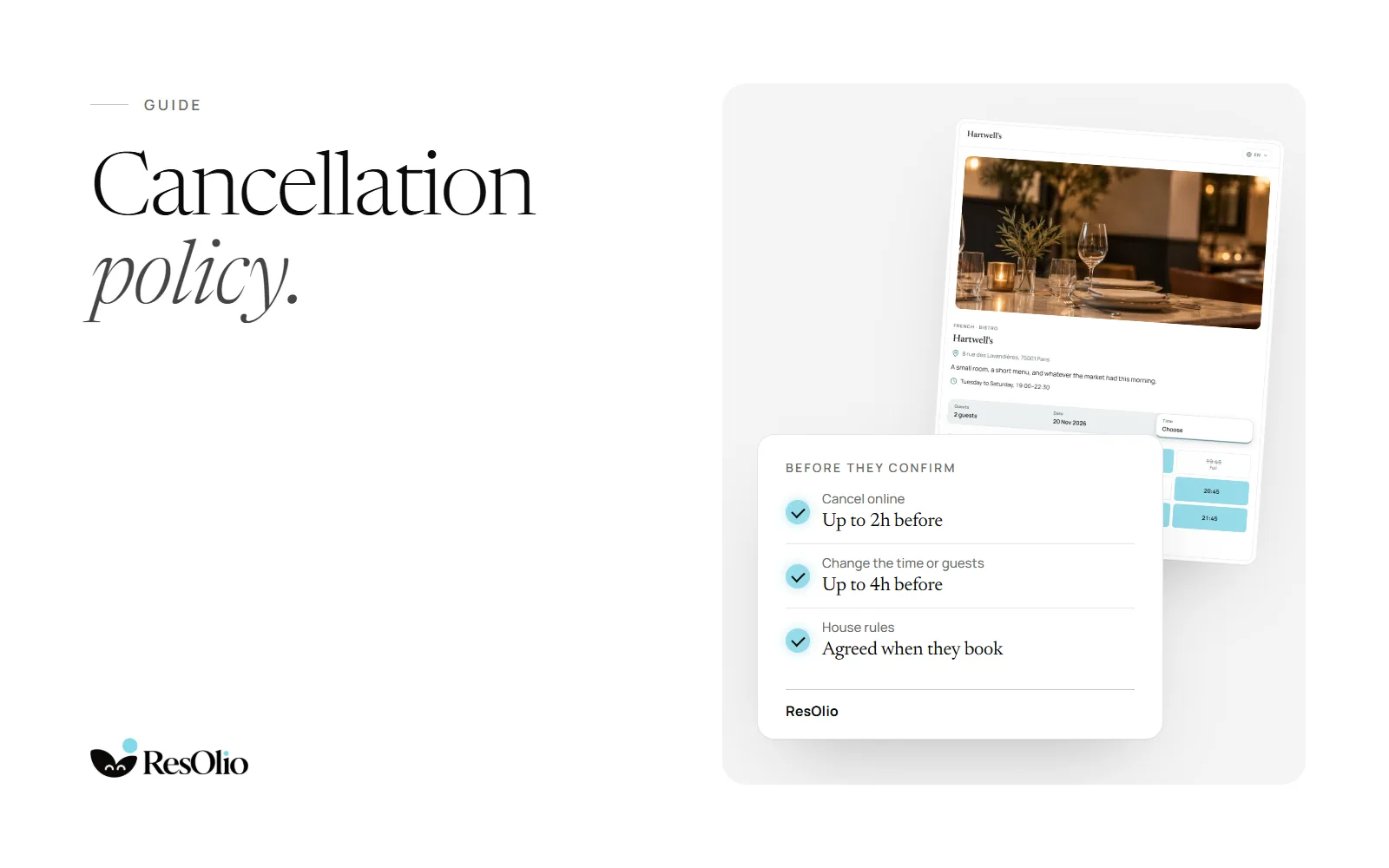
A restaurant cancellation policy without a deposit tells guests what you expect of them, before they book, without asking for a card. It does not need to be long, or written like a contract. It needs to be clear, fair and read at the right moment.
Here are the four parts every policy needs, how to choose your deadline, and three versions to copy: a bistro, a fine-dining room and a café.
The four parts of a cancellation policy
Before booking, a guest has four questions. Until when can I cancel? What if I’m late? What if I don’t come? What if we are a big group?
Your policy answers each one in a sentence:
- The deadline: until when guests can cancel or change without calling you.
- Late arrivals: how many minutes you hold the table.
- No-shows: what happens when someone neither comes nor tells you.
- Groups: from what size the rules change.
Everything else, such as a dress code or dogs, is a house rule, not a cancellation rule. Keep your cancellation rules short and together, so they read in one go.
Choosing the deadline
There is no right number for everyone. The right deadline is the one that leaves you time to give the table to someone else. Ask yourself: if a table for four frees at six, can you still fill it for eight?
- A bistro with walk-ins can accept a cancellation right up to the booking time: a freed table can fill from the door.
- A tasting menu is bought and prepared ahead, so 24 hours is easy to defend.
- A group deserves a longer deadline than everyone else, such as the day before.
A long deadline has a cost too. Once it has passed, a guest whose plans changed has no easy way to tell you, and may simply not come.
A 2025 study of restaurant guests, in the International Journal of Consumer Studies, found that a strict policy with a hard way to cancel did lower no-show intentions, but also made people less willing to book. Its authors suggest lenient terms and an easy way to cancel.
Separate cancelling from changing. A guest who wants to move their time should not have to cancel and book again. You can close changes earlier than cancellations, so the kitchen knows its numbers in time and the guest still has a way out.
Late arrivals and no-shows, one sentence each
For lateness, say how many minutes you hold the table and what happens after. For no-shows, say what you will do if it keeps happening.
Guests accept rules they know about. In a Cornell study of how diners see reservation policies (2011), people who knew a policy better were more likely to find it acceptable and fair, and holding a table for the guest was among the policies rated most acceptable.
Two sentences are enough:
“We hold your table for 15 minutes after your booking time. After that, it may go to other guests.”
“If you can’t come, please tell us, even at the last minute: someone else would love the table.”
For the late rule in full, read how long to hold a table for late guests.
Groups: notice, final numbers, your yes
A table for twelve that never comes costs you a night. Groups deserve their own rules:
- Final numbers: ask for them the day before, or that morning.
- A group that grows: say whether guests can add people online, or must call.
- Your approval: above a certain size, the booking waits for your yes.
- A group that arrives smaller: say what you will do, such as resetting the table for the people who came.
In ResOlio, turn on “Ask me first” in Settings › General, and online bookings from large parties wait for your yes: from 8 people, unless you change the number. The guest is told it is a request, and by when you will answer. Bookings your team takes never wait, and your team can book any group your tables can seat, pushing tables together if needed.
Table time: say it before they book
How long a table is theirs is part of your booking terms, even when it is not in your cancellation policy. A guest who knows the table is theirs for two hours is not surprised when you need it back.
- Set a time for each service, and a longer one for big groups, who stay longer.
- Say what a late party gets: does their table still end on time, or do they keep their full time if the table allows?
- Write it in numbers: “the table is yours for two hours” is clearer than “time limits apply”.
In ResOlio, each service has its own table time, with longer ones by party size. Once a guest picks a time, the booking page shows how long the table is theirs. And in Settings › Availability, “Late arrivals” decides what a late party gets: “Keep the booked end” or “Keep the full sitting”.
Where guests must read it
A rule a guest finds out about afterwards is not a rule. It should appear in three places:
- Before booking, on the form, where booking means agreeing to it.
- In the confirmation email, with a link to change or cancel.
- On their booking’s own page, with the deadline and your phone number.
If guests book from your website too, check the policy shows at the moment of booking, not only on a separate page.
A restaurant cancellation policy without a deposit: how it holds
A card guarantee works because a card is recorded at booking, so there is something to charge after a no-show. A Paris law firm describes it as a pre-authorisation on that card (2026). With no card, there is nothing to charge.
A policy without a card holds in other ways:
- A reminder before the night, with the link to cancel.
- A request to confirm, so you know who said yes, and who said nothing.
- Releasing a table nobody confirmed, after warning the guest.
- A rule for repeat no-shows, applied only when you know the guest was reached.
The gain is simple: nobody pays to book, and there is no charge to argue about the next day. For the deposit question in full, see how to reduce no-shows.
Three cancellation policies to copy
Change the numbers to suit your room. They are examples, not standards.
A bistro
“You can change or cancel online up to 2 hours before, from the link in your confirmation email. We hold your table for 15 minutes. From 8 people, your booking waits for our yes, and we ask for final numbers the day before. Can’t make it? Tell us, even at the last minute.”
A fine-dining room
“Our menu is prepared ahead, so please tell us at least 24 hours before if you can’t come or your numbers change. Mention any allergy when you book. We hold your table for 15 minutes. Groups of 6 or more confirm their numbers 48 hours before.”
A café
“You can cancel online right up to your booking time. We hold your table for 10 minutes, then give it to guests who are waiting. Walk-ins are always welcome.”
In ResOlio, take the deadline sentence out of these: your page already writes it from your settings. Put the rest in your house rules.
How ResOlio writes it for you
In ResOlio you don’t type the cancelling sentence. It is built from your settings in Settings › General, so your page never promises more than the system allows. With the settings a new restaurant starts with, guests read this on the form once they pick a time:
“Cancel online up to 2h before · Change the time or the number of guests up to 4h before.”
- Your deadlines, on every plan. Choose whether guests can cancel or change themselves, until when, how many times, and whether they can add people. See General settings.
- Your house rules, on every plan. Guests agree to them when they confirm, and the window your embed opens prints them in full. See house rules.
- The guest’s own booking page, on every plan. They change or cancel there. It tells them until what time they can cancel, and past it, gives them your phone number. See change or cancel.
- In English, French and Arabic, on every plan. The deadline sentence and the guest’s emails follow the language they booked in, and Arabic reads right to left.
- Reminders, on every plan. The reminder that asks guests to confirm comes with Starter (€39 a month).
- Releasing unconfirmed tables and the no-show record, on Pro (€99 a month). A no-show counts only when the guest was reached, and stays on the record for twelve months.
- No card. Your guests never pay to book.
Free takes up to 50 bookings a month. Every plan is on the pricing page.
Questions
How many hours’ notice is fair for a small restaurant?
Enough to give the table to someone else. A few hours can be enough with walk-ins; a menu prepared ahead needs the day before. A new ResOlio restaurant starts at 2 hours for cancelling and 4 for changes, and you set your own.
Can a guest still cancel online after the deadline?
Not in ResOlio: past the deadline, their booking’s page gives them your phone number instead. Always let them call. A late cancellation is better than an empty table.
Do I need a cancellation policy if I never charge a fee?
Yes. It tells guests what to do when plans change, and gives you a rule to apply to repeat no-shows. Without a fee, it is what sets expectations.
What if a group arrives with fewer people?
Say what you will do in your policy, and ask for final numbers the day before. In ResOlio, a guest can lower the party from their booking before your change deadline without using up a change, and your team can change the number on the booking.
Can I charge a no-show if I took no card?
With no card recorded at booking, there is nothing to charge. ResOlio takes no card, so your guests are never charged. This is a fact about how card guarantees work, not legal advice.
Should the policy be in more than one language?
If your guests book in more than one, yes. In ResOlio, the deadline sentence appears by itself in English, French and Arabic. You write your house rules once for each language; a language you haven’t written shows your English, or another language you did write.
Sources
- International Journal of Consumer Studies: The effects of restaurant cancellation policies and no-show awareness campaigns on reservation behaviors (2025) digitalcommons.montclair.eduread on
- Journal of Revenue and Pricing Management: Customer attitudes towards restaurant reservations policies (2011), Cornell eCommons ecommons.cornell.eduread on
- Kohen Avocats: Empreinte bancaire au restaurant et no-show (30 September 2026, in French) kohenavocats.frread on
Something wrong? Tell us
Take bookings with no fee per cover
Set it up in three short steps, with no card.